Why EU Buyers May Shift Ceramic Tile Sourcing to India After the FTA
Global sourcing decisions rarely change overnight.
They shift when cost, risk, and reliability intersect.
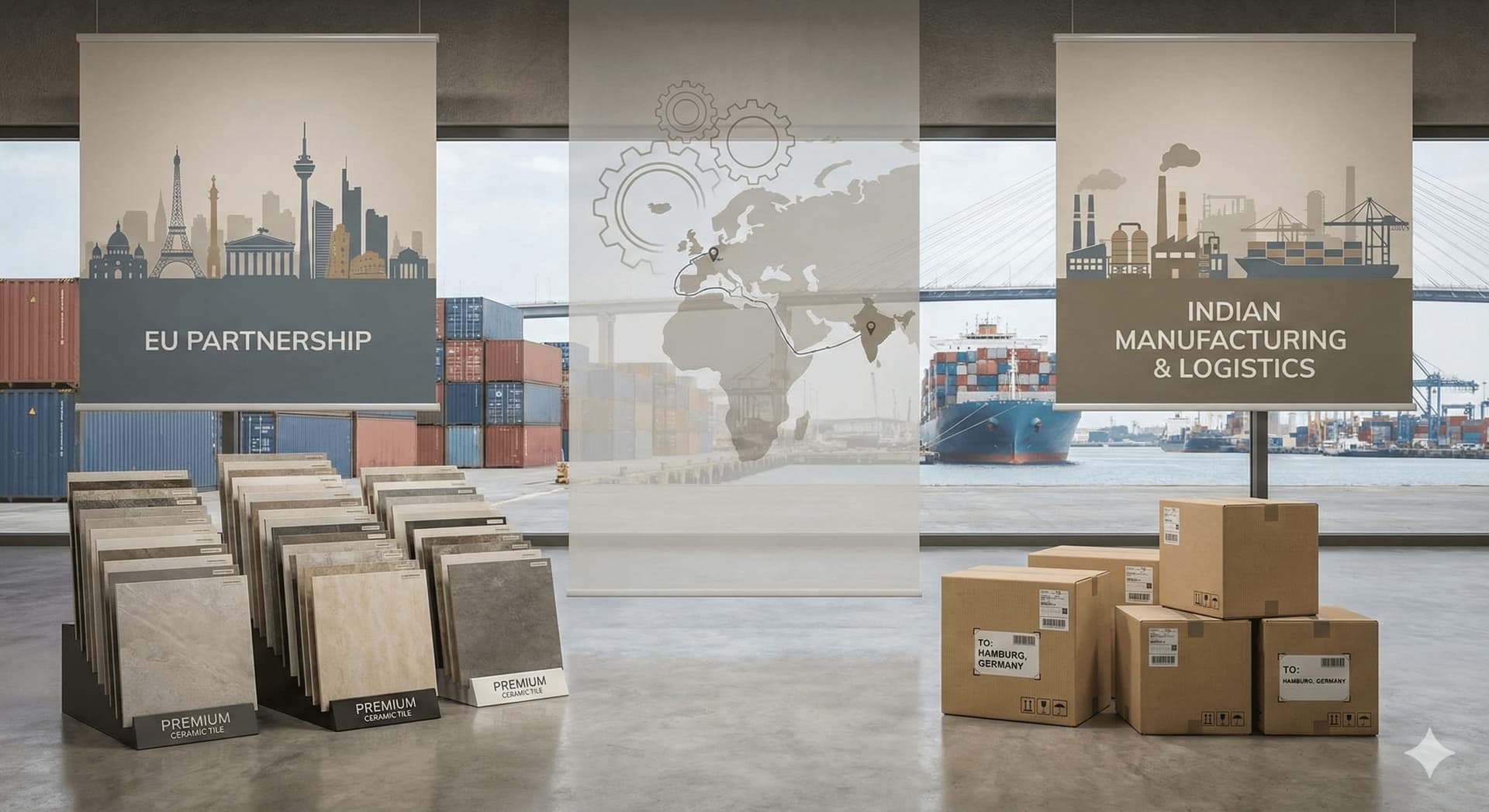
The proposed India–EU Free Trade Agreement (FTA) is creating exactly that intersection—especially for ceramic tiles. For many EU buyers, India is no longer just an alternative sourcing option; it is becoming a strategic priority.
This article explains why EU buyers may increasingly shift ceramic tile sourcing to India after the FTA and what factors are driving this transition.
1. Tariff Reduction Changes Landed Cost Economics
Ceramic tiles are a high-volume, cost-sensitive product. Even modest tariff reductions can significantly alter landed cost.
Under the FTA framework, potential duty reductions would:
- Lower import costs for EU buyers
- Improve pricing competitiveness of Indian tiles
- Allow better margin control without sacrificing quality
Annotation:
In tiles, a few percentage points in duty can decide the supplier country.
2. Rising Production Costs Within Europe
European tile manufacturing faces growing pressure from:
- High energy costs
- Environmental compliance expenses
- Labor costs
- Capacity constraints
These factors are pushing EU buyers to look beyond traditional domestic sourcing.
India offers:
- Cost-efficient manufacturing
- Large-scale production capacity
- Flexible output planning
The FTA strengthens India’s position as a long-term cost-stable sourcing base.
3. Supply Chain Diversification Is Now a Priority
Recent global disruptions have reshaped buyer thinking.
EU importers are actively reducing dependency on:
- Single-country sourcing
- Limited supplier pools
India provides:
- Multiple manufacturing clusters
- Strong export infrastructure
- Scalable supply across price segments
Annotation:
Diversification is no longer optional—it’s a risk strategy.
4. Indian Tile Quality Has Reached Global Standards
A common misconception is that lower cost means lower quality.
In reality, Indian ceramic tile exporters have significantly improved:
- Product consistency
- Technical specifications
- Design realism
- Export-grade packing
Many Indian suppliers already serve demanding markets worldwide.
Annotation:
EU buyers don’t compromise on quality—Indian exporters know this.
5. Design Alignment with EU Market Preferences
European markets favor:
- Wood-look and stone-look tiles
- Matte and natural finishes
- Large-format tiles
- Minimalistic, timeless aesthetics
Indian manufacturers have rapidly adapted design portfolios to meet these preferences, often with faster turnaround than traditional suppliers.
6. Strong Fit for Private Label Programs
Private label sourcing is growing across the EU.
India is particularly well suited for private label tile programs because of:
- Flexible manufacturing
- Custom packaging capability
- SKU control
- Long-term batch consistency
Annotation:
Private label buyers value control more than factory branding.
7. Improved Trade Framework Reduces Friction
Beyond tariffs, FTAs improve:
- Customs cooperation
- Documentation alignment
- Regulatory clarity
This reduces clearance delays and administrative risk—critical for EU buyers operating on tight schedules.
8. Logistics and Export Expertise Are Mature
India’s ceramic tile export ecosystem has matured.
Key strengths include:
- Export-focused packing standards
- Container optimization
- Port handling experience
- Global shipping connectivity
Merchant exporters play a vital role in managing multi-factory sourcing under one export system.
9. Competitive Pricing Without a “Race to the Bottom”
EU buyers are not looking for the cheapest tiles—they are looking for sustainable value.
India offers:
- Competitive pricing
- Stable supply
- Quality consistency
- Long-term scalability
This combination reduces the need for constant supplier switching.
10. Strategic Long-Term Outlook
The FTA is not a short-term opportunity—it signals long-term alignment.
EU buyers who shift early can:
- Secure stronger partnerships
- Lock in supply advantages
- Build differentiated product ranges
Late movers may face capacity constraints and higher prices.
Final Thought
EU buyers may shift ceramic tile sourcing to India not just because of tariffs—but because the fundamentals now align.
Cost efficiency, quality maturity, supply diversification, and improved trade frameworks together make India a compelling sourcing destination after the FTA.
In global trade, shifts don’t happen because of one reason.
They happen when enough reasons align at once.
Conclusion
The India–EU FTA could accelerate a sourcing shift that was already underway. For EU buyers, India offers competitive pricing, scalable production, private label compatibility, and reduced trade friction. For Indian exporters, it represents an opportunity to become long-term strategic partners in the European tile market.
Trade agreements open doors.
Prepared partners walk through them first.