How the India–EU Free Trade Agreement Can Reshape Ceramic Tile Sourcing
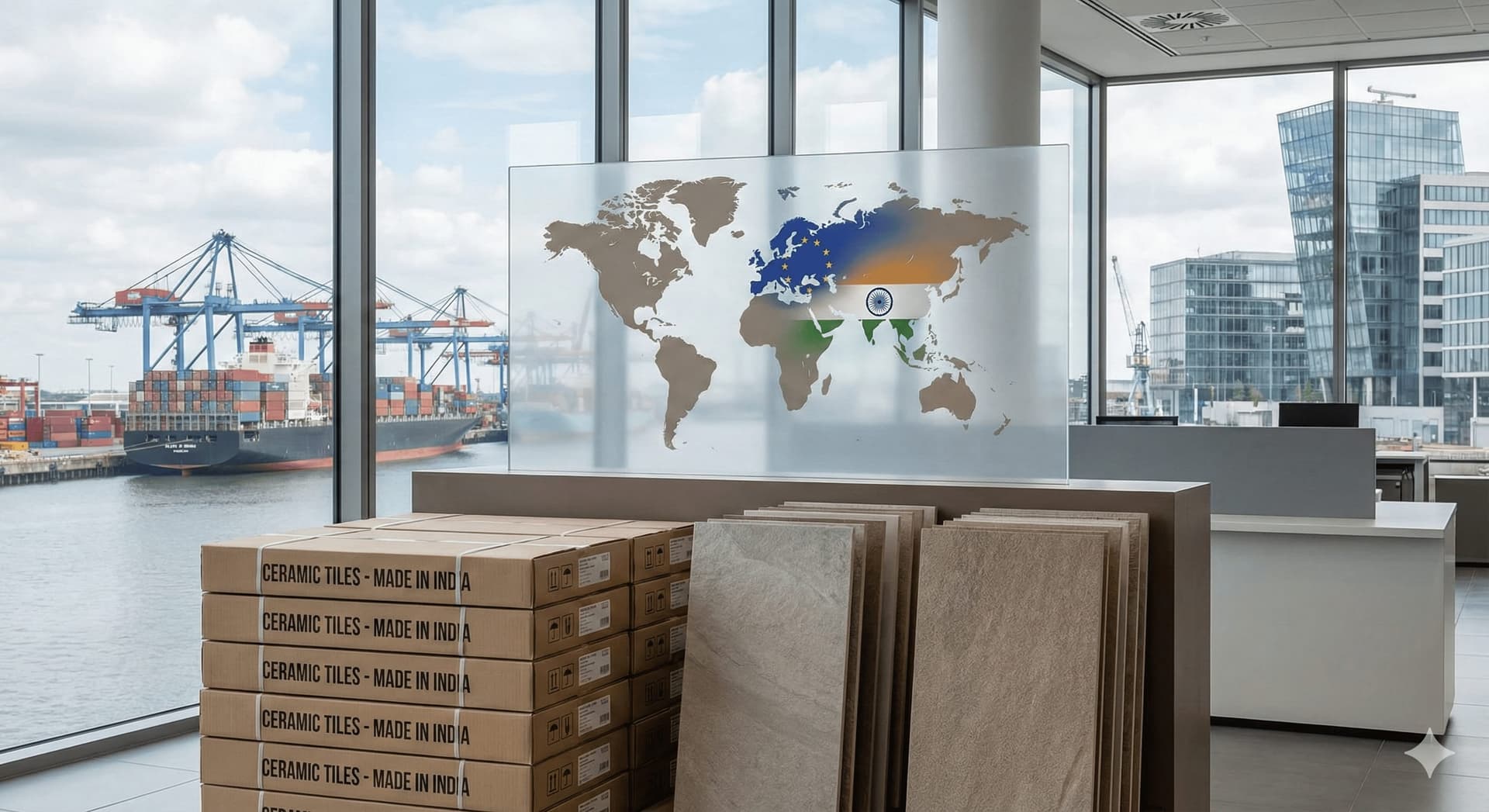
Global sourcing patterns do not change because of trends alone.
They change when cost structures, supply risk, and trade frameworks shift together.
The proposed India–EU Free Trade Agreement (FTA) has the potential to create exactly such a shift in the ceramic tile industry. For EU importers and distributors, this agreement could redefine where tiles are sourced from, how supply chains are built, and which partners gain long-term advantage.
This article explains how the India–EU FTA can reshape ceramic tile sourcing—and what it means for buyers planning ahead.
1. Why the India–EU FTA Matters for Tile Imports
Ceramic tiles are a volume-driven, logistics-intensive product. Even small trade barriers significantly affect pricing and sourcing decisions.
The India–EU FTA aims to:
- Reduce or eliminate import duties
- Simplify trade procedures
- Improve regulatory alignment
Annotation:
In tile trade, reduced friction matters as much as reduced tariffs.
2. Tariff Reduction and Landed Cost Impact
EU buyers closely monitor landed cost, not just ex-factory price.
If tariffs on Indian ceramic tiles are reduced:
- Indian tiles become more price-competitive
- Buyers gain flexibility in retail pricing
- Margins improve without sacrificing quality
This makes India a stronger alternative to traditional sourcing regions.
3. Europe’s Rising Manufacturing Constraints
European tile production is facing structural challenges:
- High energy costs
- Strict environmental regulations
- Labor cost pressure
- Limited capacity expansion
These factors push EU buyers to look beyond domestic supply.
India offers:
- Large-scale manufacturing capacity
- Competitive cost structures
- Faster scalability
The FTA strengthens this cost-stability advantage.
4. Supply Chain Diversification as a Strategic Need
EU buyers are actively reducing dependency on:
- Single-country sourcing
- Limited supplier bases
India provides a diversified sourcing ecosystem with:
- Multiple manufacturing clusters
- Established export infrastructure
- Ability to support both volume and premium segments
Annotation:
Diversification is now a sourcing strategy, not a backup plan.
5. Indian Tile Quality and Export Maturity
Indian ceramic tile exporters have evolved significantly.
Key improvements include:
- Better calibration and size consistency
- Advanced digital printing for design realism
- Stronger quality control systems
- Export-grade packing standards
These upgrades align Indian tiles with EU market expectations.
6. Alignment with EU Design Preferences
EU buyers favor:
- Wood-look and stone-look tiles
- Matte and natural finishes
- Large-format tiles
- Minimalist, timeless aesthetics
Indian manufacturers have increasingly aligned product development with these preferences, offering EU-focused collections.
Annotation:
Design alignment accelerates acceptance in new markets.
7. Growth of Private Label Sourcing
Private label programs are expanding across Europe.
India is well positioned for private label tile sourcing due to:
- Flexible production
- Custom packaging capabilities
- Consistent batch control
- Long-term SKU management
This allows EU buyers to build brand equity rather than compete on factory names.
8. Trade Framework Improvements Beyond Tariffs
The FTA is not just about duties.
It also improves:
- Customs cooperation
- Documentation clarity
- Regulatory predictability
These factors reduce clearance delays and operational uncertainty.
Annotation:
Predictability is as valuable as cost savings in international trade.
9. Role of Export-Focused Supply Partners
As sourcing becomes more complex, EU buyers increasingly rely on:
- Merchant exporters
- Export-focused coordinators
These partners manage:
- Multi-factory sourcing
- Quality consistency
- Logistics and compliance
This simplifies sourcing while maintaining flexibility.
10. Long-Term Strategic Shift, Not a Short-Term Gain
The India–EU FTA represents a long-term realignment.
Early adopters can:
- Secure strong supply partnerships
- Lock in capacity
- Build differentiated product ranges
Late movers may face higher prices and limited availability.
Final Thought
The India–EU FTA has the potential to reshape ceramic tile sourcing by aligning cost efficiency, supply reliability, and trade facilitation.
For EU buyers, India becomes not just an alternative—but a strategic sourcing hub.
For Indian exporters, it is an opportunity to move from transactional supply to long-term partnership.
In global trade, agreements open doors.
Prepared businesses decide who walks through first.
Conclusion
The India–EU Free Trade Agreement could mark a structural shift in ceramic tile sourcing. Reduced tariffs, improved trade processes, and India’s manufacturing scale together create a compelling case for EU buyers. Success will depend on quality consistency, compliance discipline, and relationship-driven sourcing strategies.
Trade frameworks change markets.
Execution defines winners.